Whenever I’m out cruising, I like to be prepared for chance encounters. You never know when you’ll strike up a conversation at the fuel dock, the dinghy dock, or the oyster bar. That’s why I always keep a stack of my boat cards handy. They’re not just business cards for boaters—they’re stylish little introductions that say, “Here’s who I am, here’s my boat, let’s stay in touch.” There’s something refreshingly analog about handing someone a card instead of fumbling with phones and trying to remember names like “Bob from Blind Channel with the yellow kayak.” Boat cards bring a sense of elegance, friendliness, and a little bit of flair to life on the water.
Boat cards are like business cards, but way more fun. They’re your personal introduction, your floating identity, your invitation to stay in touch. Whether I’m swapping provisioning tips with a fellow cruiser, chatting with a Navigator owner at anchor, or sharing stories over a docktail, I always pull out one of my cards. It’s a charming, elegant way to say: “Nice to meet you—here’s where to find me again.”
That’s why I believe understanding why every boater needs a Boat Card is essential for all boaters.
What’s on My Boat Card?
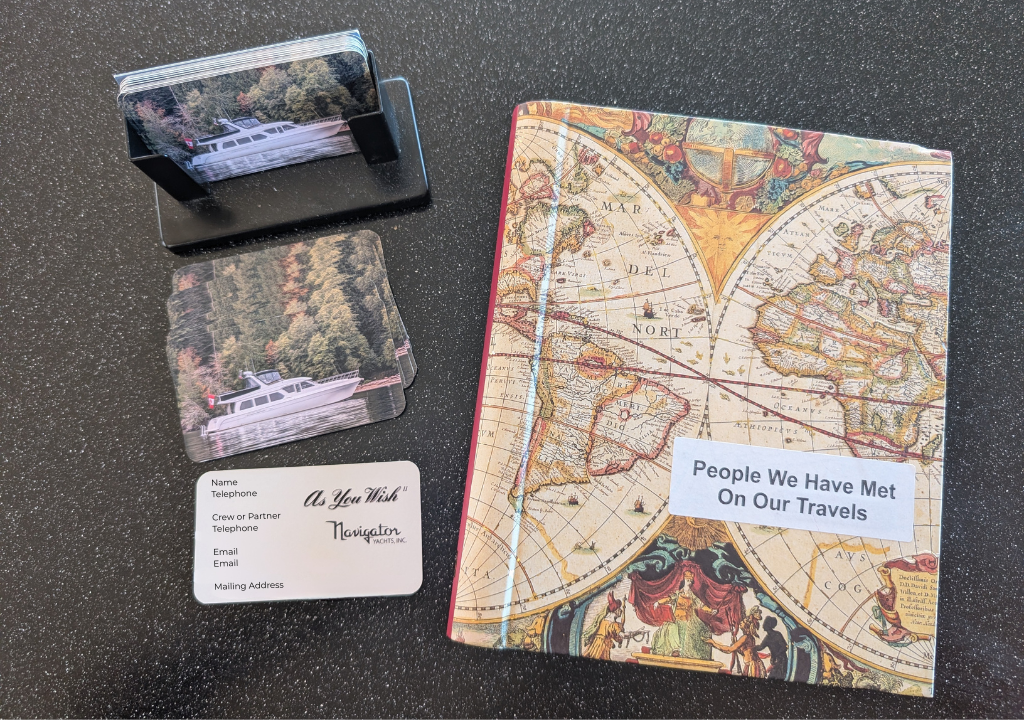
The front of my boat card is all about making a good first impression. A beautiful photo of my boat. It can be from the side or the stern with your boat name visible, if you like. I include the Navigator logo because I love meeting boaters with the same style of boat.
The back includes all the essentials:
- My name
- Cell phone
- Crew or Partners Contact Info
- Mailing address (yes, even us nomads have one!)
- Boat name & hailing port
- Instagram handle
Why Do Boat Cards Matter?
Because boating is about connection, you meet people everywhere—at the marina laundry room, stern-tied in Prideaux Haven, or hiking back to the marina from the grocery store with your shopping cart. And when you meet a good one, you want to remember them.
Sure, you could exchange numbers on your phone, but what are you going to save them as? “Guy from Sonora?” “Nice couple with a schnauzer?” No. A boat card makes it official. It reminds people who you are, what your boat looks like, and gives them everything they need to follow up. Plus, it’s a power move—trust me.
How to Make Your Own Boat Cards in Canva
Let’s get down to business—making your cards. You don’t need to be a graphic designer or own a laminator (though that’s very boaty of you). Just follow these steps:
Step 1: Take a Great Photo of Your Boat
This will be the star of the front of your card. I recommend one at anchor, full length from stern to bow. Bonus points if your boat dog is in the frame.
Step 2: Go to Canva.com
Canva is a free, user-friendly design site that makes you look like you know what you’re doing. (They have a paid version too, but the free one is plenty for this.)
Step 3: Choose the Business Card Template
Search “business card” in the templates bar and select a blank, two-sided template.
Step 4: Design the Front (Side One)
- Upload your boat photo.
- Add your boat name in a clean, nautical font (I like Montserrat or DM Sans).
- Add your logo if you have one (or let this be your excuse to design one—Canva has icons and elements to play with).
- Don’t forget the manufacturer logo—fellow owners love that touch. Search online, i.e. Navigator, Fleming, Riviera, etc. Canva will even help you “remove background” so the logo is transparent.
Step 5: Design the Back (Side Two)
Include the essentials:
- Name(s)
- Cell phone
- Mailing address (or P.O. Box)
- Instagram or website
- Optional: MMSI, boat length, hailing port
Make sure the font is legible. I like a white background with navy or black text. The clean background allows you to write notes if you wish.
Step 6: Download Your Design
Once you’re happy with the front and back, download it as a print-ready PDF (with crop marks and bleed, if prompted).
Where to Print?
Option A: Canva Print
If you want to keep it simple, just click “Print” right in Canva. They offer premium paper, rounded corners, and eco-friendly options.
Pricing (Canva Print, matte or gloss finish):
- 250 cards: approx. $65 CAD
- 500 cards: approx. $90 CAD
(Shipping is usually included, and they often have deals.)
Option B: Vistaprint
If you want more customization, have a promo code from your last Vistaprint order or found an online “first order” coupon? Download the artwork from Canva and upload it to Vistaprint.
Pricing (Vistaprint, standard paper, full colour, front & back):
- 250 cards: around $30–40 CAD
- 500 cards: around $50–60 CAD
(Pro tip: sign up for their email list for coupons—they always have one!)
Hot Tip: Keep Your Cards Handy
Keep a stash at the back door, on your dinghy or in your dog-walking jacket pocket. You’ll use them more than you think—at marinas, potlucks, flotillas, and those magical moments when you raft up beside a kindred spirit.
How To Organize The Cards You Receive
And here’s a little tip for the fellow boat card collectors among us—I keep an old-school address book onboard just for the cards I receive. Instead of filing by last name (which, let’s be honest, we rarely remember), I organize the entries by boat name. “Seas the Day,” “Knot Working,” “Whiskey Charlie”—they all have a spot in my log of nautical friendships. It’s fun to flip through and remember where we met, what we talked about, and which anchorage we shared. Plus, it makes it easy to reconnect when you find yourself moored beside a familiar name.
It’s also great to organize actual business cards from marinas, or boat repair and provisioning stops.
This is the one I have used for years!
A stylish and seaworthy address book designed to collect boat cards and organize your cruising connections.

Final Thoughts
In a world full of quick texts and fleeting connections, there’s something beautifully old-school and deeply elegant about the boat card. It says you’re here, you’re anchored, and you’re part of a community that values connection, conversation, and classy touches. Plus, if you’re anything like me, you like things with your boat name on them. So go ahead—print the cards. Be the one who makes the first move. After all, boating friendships start with a wave..… and maybe a really good calling card.