There are some boat projects you do because something is broken. Others because something is old, not working or not suited for the way you boat. And then there are the projects that change the way you use your boat, like The Boat Upgrade That Changed How We Anchor.
Our anchor locker was one of those.
When we bought our 2007 Navigator 5800, it came with approximately 200 feet of anchor chain. The chain was old, rusty in places and had a few links that made us uncomfortable. But the bigger problem was something we didn’t fully appreciate until we started anchoring regularly: the anchor locker was simply too small and too shallow for the way we boat.
We spend our summers cruising the Pacific Northwest, where some of our favourite anchorages are surprisingly deep. Fifty to eighty feet isn’t unusual. Suddenly, 200 feet of chain doesn’t seem like very much. This is an upgrade we highly recommend: The Boat Upgrade That Changed How We Anchor. It has transformed our anchoring experience.
The Problem Wasn’t Just the Chain
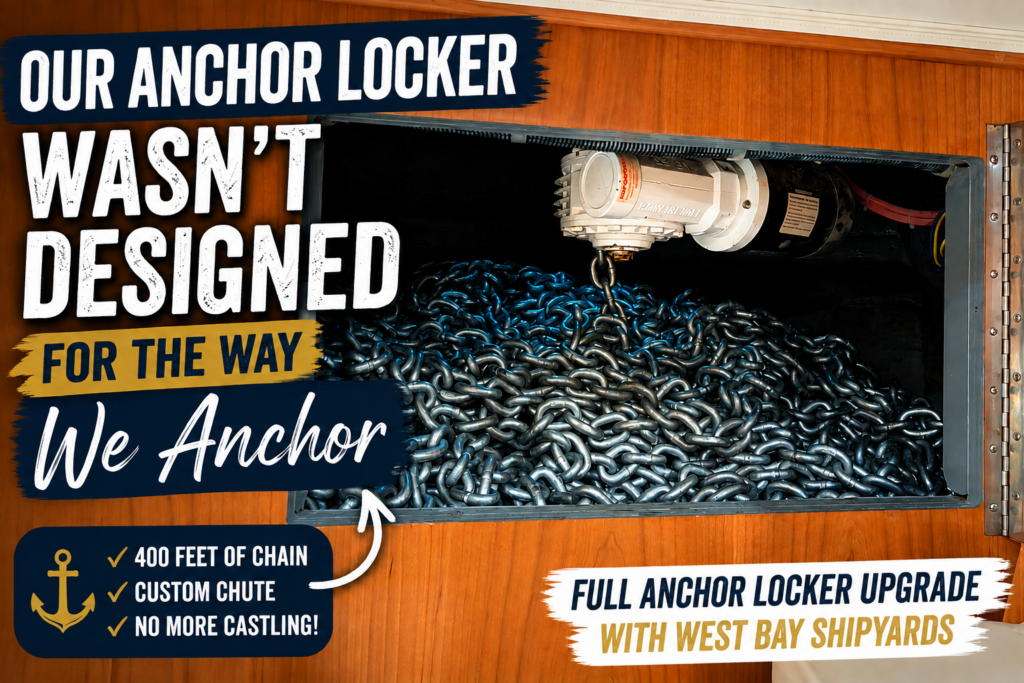
At first, the obvious solution seemed simple: replace the old chain with more chain. We decided on 400 feet of continuous galvanized anchor chain, giving us considerably more flexibility when anchoring in the deeper bays and inlets we love. Here is a video about that project!
Except there was a problem. Where was all that chain going to go?
Our existing anchor locker wasn’t particularly good at handling 200 feet. As we retrieved the anchor, the chain would pile directly beneath the windlass instead of falling naturally into the locker. Eventually it would build itself a little metal mountain. We call this castling.
Once the pile became high enough, the incoming chain had nowhere to go. Someone had to go below and manually move, or flake the chain around the locker while the person on the bow continued retrieving it. It was annoying with two people. By myself, it would become a serious problem.
The Day I Knew We Had to Fix It
That became very clear one day at Rebecca Spit. I was aboard by myself when the wind started to come up, and I needed to retrieve the anchor. This is exactly the sort of situation where your boat systems need to work with you. Instead, I had a system that required one person at the helm to operate the windlass and another below to handle the chain. There were not, unfortunately, two Missys aboard. That experience changed my thinking about the entire project. The question was no longer, “How do we fit more chain aboard?” It became, “How do we make the anchoring system work properly for the way we actually boat?”
That distinction is important. We Changed the Boat Instead
We took the boat to West Bay Shipyards and started looking at what was beneath the existing anchor locker. There was unused space below it. And that gave us an idea. Rather than trying to cram 400 feet of chain into essentially the same space, West Bay cut through the bottom of the existing locker and extended it downward, creating a much deeper space for the chain to fall into.
It sounds wonderfully straightforward when I describe it now. Cut a hole. Make the locker deeper. Problem solved. As with most boat projects, the actual execution required considerably more thought than that. The new space had to accommodate the chain properly, drain correctly and work with the existing windlass and ground tackle. But the principle was beautifully simple. Gravity needed more room to do its job.
In this video, I take you through the project, including the original anchor locker, the problems we were having, the work completed by West Bay Shipyards and the finished result.
YouTube video: The Boat Upgrade That Changed How We Anchor / Full Anchor Locker Upgrade with West Bay Shipyards
Why We Chose 400 Feet of Chain
Four hundred feet may sound excessive if you normally anchor in relatively shallow water. For us, it isn’t. Our Navigator is a substantial cruising boat, and we regularly explore anchorages where depths vary from 40-foot sandy bottoms to 90-foot rock bottoms. Pendrell Sound is a good example. The scenery is spectacular, but finding an appropriate depth and enough room to stern tie can require considerably more rode than you might expect.
Having 400 feet aboard doesn’t mean we’re putting 400 feet out every time we anchor. It means we have options. And options are a very nice thing to have when the weather changes or when the perfect anchoring spot turns out to be deeper than anticipated.
Then We Had to Test It
Of course, no boat project is finished simply because it looks beautiful at the dock. You have to use it. Our first tests were enormously satisfying. The chain finally had enough vertical clearance to fall naturally rather than pile up beneath the windlass.
Later, while cruising from Newcastle Island to Tribune Bay, we got another opportunity to put the new system through its paces. We were anchored in approximately 40 feet of water with roughly 150 feet of chain out. As we retrieved it, we could see our chain markers coming aboard, watch the chain feed properly into the new locker and deal with the inevitable muddy anchor. And nobody had to run downstairs and rearrange 150 feet of chain.
Success.
One Upgrade Led to Another Lesson
Changing our anchor system also made us think more carefully about the entire logistics of anchoring. The windlass is designed to raise and lower the anchor. We don’t want the windlass and gypsy taking the constant loads created as a heavy boat moves against its chain. That’s why we use a two-leg bridle-style anchor snubber. Once the anchor is set, the bridle clips onto the anchor chain and its two legs lead back to the port and starboard bow cleats. We then ease additional chain, so the load transfers from the windlass to the bridle. It also adds some elasticity to an otherwise all-chain system and helps reduce the noise and vibration of chain moving across the bottom.
Watch: Why We Use an Anchor Snubber
I made a separate video showing exactly how we attach our two-leg bridle and why we use it.
The Bigger Lesson
The most valuable thing I learned from this project had very little to do with fibreglass or anchor chain. Your boat doesn’t have to remain exactly as the manufacturer built it. Boats are designed around assumptions about how their owners will use them. But after you’ve cruised for a while, you begin to discover your boat. You learn where you naturally put things. You discover which systems make life easier and which ones cause unnecessary work. You learn how much water you use, how you provision, where you anchor and what you need when you’re operating the boat with fewer hands aboard.
Those annoyances are information. If you’re constantly fighting the same system, don’t automatically assume you need to get better at working around it. Sometimes the system needs to get better at working for you.
Our anchor locker is a perfect example. We wanted to anchor confidently in the places we love, carry the amount of chain appropriate for the way we cruise and be able to retrieve our anchor without someone stationed below wrestling with a pile of chain.
Now we can.
And every time that chain disappears neatly into the locker, I still get a ridiculous amount of satisfaction watching it happen. Sometimes the best boat upgrade isn’t the shiny new thing everyone can see.
It’s the one that quietly makes your boat work better.