Every summer on the boat teaches me something. Sometimes it’s practical: a better way to provision, an anchorage I want to return to, or another little job to add to the winter project list.
But this summer there was a shift. I was out for three and a half months straight, the longest stretch yet. And the boat taught me something bigger. The more I understand our boat, the more confident I become. Not because I’ve reached some magical point where nothing goes wrong. This is a boat, after all. It’s because when something changes, I have a much better idea of what I’m looking at, what the boat is telling me and what we should do next.
Reflecting on these lessons, I can confidently say that What the Boat Taught Me This Summer has led to personal growth and a deeper understanding of boating.
And I’ve realized that much of that confidence has come from decisions we’ve made over the past few years, not just about the equipment we’ve installed, but about how it was installed and how well we’ve learned to use it.
Good Equipment Is Only Half the Equation
I am a great believer in hiring professionals for the things that matter. When we upgraded and integrated our navigation equipment, we worked with Pacific Yacht Systems. Could we have saved money trying to piece parts of it together ourselves? Possibly. Would I make that choice now? Absolutely not.
There’s a tendency in boating to look at professional installation and think, “That seems expensive.”
I’ve come to look at it differently. It’s expensive when something isn’t installed properly.
It’s expensive when equipment doesn’t communicate with another piece of equipment. It’s expensive when something fails at exactly the wrong moment. And it’s especially expensive when you’ve bought sophisticated equipment but can’t take advantage of half its capabilities because the system hasn’t been installed properly.
Having professionals install and integrate our equipment has turned out to be one of the best investments we’ve made in the boat. Because when it works, you use it. And when you understand it, you trust it.
Seventeen Feet and Faith in my Garmin
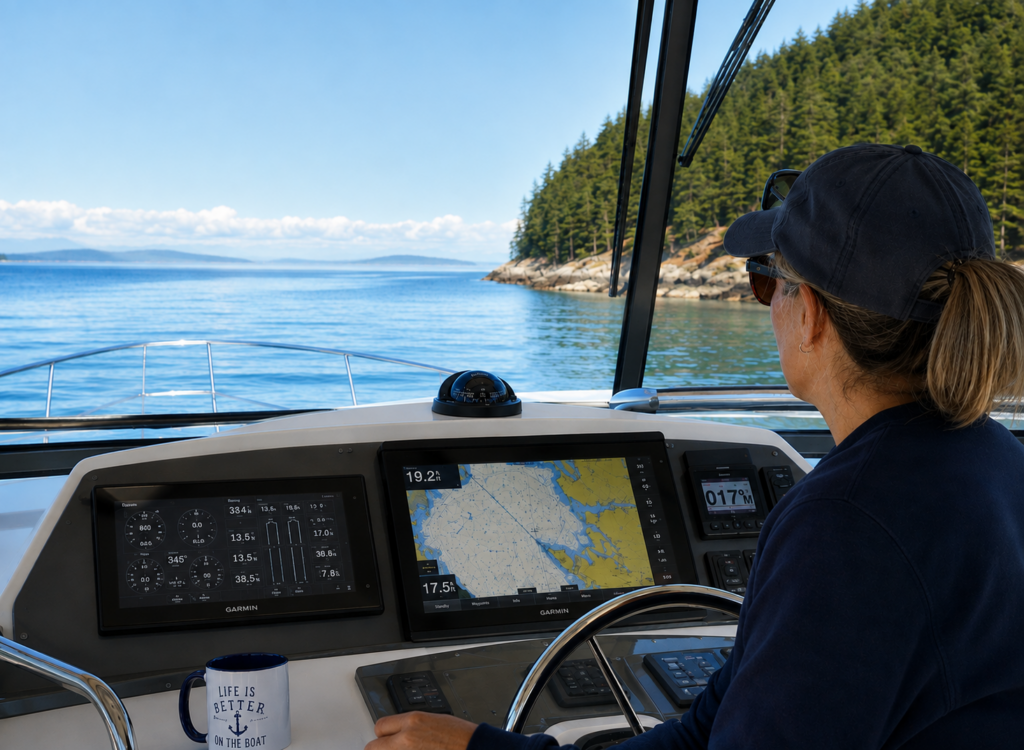
We had one of those moments this summer travelling from Tribune Bay toward Cortes Island. Our Garmin navigation system had plotted our route between St. John Point and Flora Island as we passed Helliwell Provincial Park. The water started getting shallower.
Twenty-two feet.
Nineteen.
Fifteen.
I was watching the depth sounder, thinking some version of, Are we really doing this? We saw 17.5 feet while the autopilot calmly continued along the route. There is nothing quite like staring at 15 feet on the depth sounder to make you reconsider every decision that brought you to this precise geographical location. But here’s the important part.
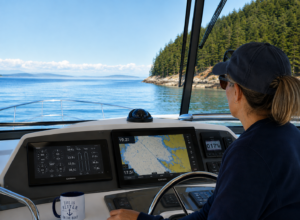
We understood what our navigation equipment was showing us because our system had been professionally installed, integrated and configured specifically for our boat. We’ve entered the important parameters for our boat, our draft, keel offset, height, and the minimum depth that we’re comfortable navigating, so the system isn’t working with generic assumptions; it knows our boat. Our Garmin chart plotters, depth sounder, and autopilot work together using real-time information from the boat.
We also carry an iPad and find it incredibly useful as a secondary navigation tool, but I would never rely on it as my primary source of navigational information. iPads can overheat and shut down in direct sunlight, lose power or connectivity, and fail to receive the same hardwired, real-time information from the boat’s systems. The iPad is an excellent backup; our integrated, hardwired Garmin system is what I trust to navigate the boat.
We aren’t just following the pink line. We were using information we understood. There’s a very big difference.
Information at Our Fingertips
The same thing has happened with our electrical system. Through our Victron system and Cerbo, we can see what’s happening aboard the boat in real time. Battery state of charge. Charging. Solar production. Power consumption. Instead of wondering how we’re doing electrically, we can look. And because we can also access information from our phones, that knowledge isn’t limited to standing in front of one panel somewhere on the boat. That has completely changed my relationship with our electrical system. Now I watch the numbers. I know what’s normal.
And perhaps more importantly, I’m much more likely to notice when something isn’t normal.
That’s what understanding your systems gives you.
Not the ability to repair absolutely everything yourself, but the ability to recognize what your boat is telling you.
Water Changed the Way We Cruise
Our water maker has been another revelation.
When we were considering adding one, we spent time getting good advice about what would work for our boat and how we cruise. We also had it professionally installed. I’m very glad we did. Making our own fresh water has fundamentally changed how long we’re comfortable staying out. Water used to be something we had to calculate. How much is in the tanks? How much are we using? How many more days can we stay here before we need to move somewhere to fill up?
Now, in the right conditions, we can make water. That means if we find a beautiful anchorage and want to stay for several days, our freshwater supply isn’t automatically dictating when we must leave. That is freedom.
We also added an Acuva UV-LED water purification system for our drinking water. Having plenty of clean drinking water aboard, and, importantly in my world, plenty of clean ice, has been another small change with an enormous impact. It isn’t glamorous equipment. Nobody pulls into an anchorage and says, “Come aboard and see my spectacular water sterilizer.”
I have this model on my boat, and it gives me great peace of mind knowing that wherever I take on water, it will be safe for drinking. It removes up to 99.9999% of harmful particles and contaminants such as rust, chlorine, fluoride, and heavy metals.

But systems like these quietly change what your boat can do.
Learn the Equipment You Already Own
There has been another part of this that didn’t cost us anything.
We started learning more.
I’ve spent time watching manufacturers’ videos. We’ve read manuals. We’ve learned what the displays are telling us, rather than simply learning which button turns something on. That sounds obvious. But think about how much sophisticated equipment we have aboard our boats that we probably use at a fraction of its capability. I certainly have.
The more I’ve learned about our Garmin equipment, Victron system, FCI Watermaker and the other systems aboard, the less mysterious the boat has become. And that’s where I’ve found confidence.
Confidence Isn’t Knowing Everything
I don’t think being a good boater means knowing how to fix every pump, wire, engine, computer and piece of equipment aboard your boat. Sometimes it means knowing when to call someone who knows considerably more than you do. I want professionals installing the systems where installation matters.
I want advice from people who understand the equipment. I want to know that the various components aboard our boat aren’t simply installed; they’ve been designed to work together.
But once the professionals leave, there’s another responsibility that belongs to us. We need to learn how those systems work. Watch the videos. Read the manual. Ask questions during the installation. Learn what normal looks like. Then actually use the equipment. Every time we do that, we add another little piece to our understanding of the boat.
The Boat I Know Now
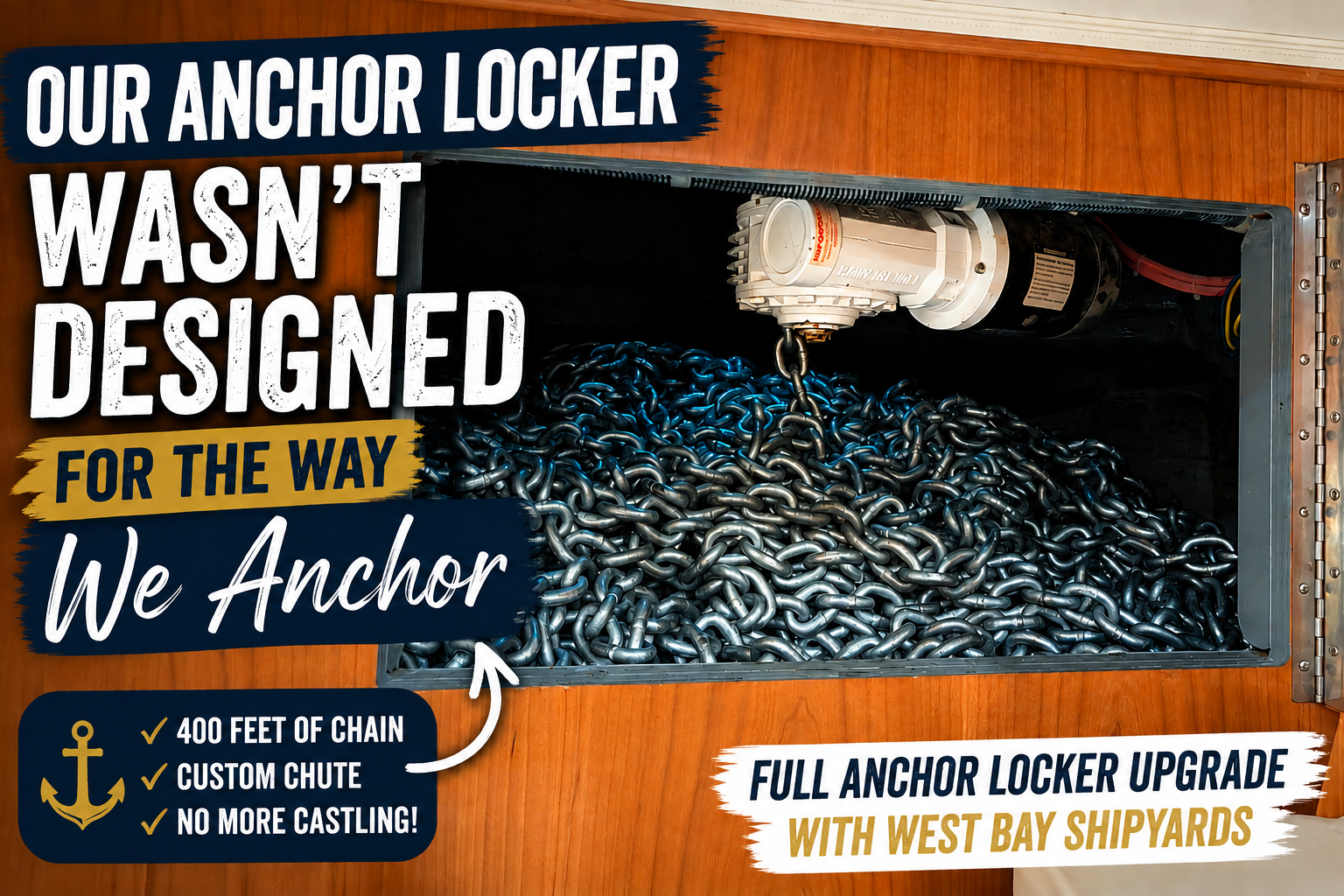
This summer we’ve navigated unfamiliar passages, watched the weather change our plans, anchored in deep water, tested our redesigned anchor locker, made our own water, monitored our electrical system, explored little islands by dinghy and cooked dinner on our new induction stovetop on rainy evenings.
And somewhere in all of that, I realized something had changed.
The boat doesn’t feel simpler. It feels more familiar. That’s different.
There are still systems aboard I want to understand better. There will still be alarms that make my heart jump, weather that changes the plan and numbers on the depth sounder I’d rather were considerably shallower or deeper. But I’m less intimidated by those moments than I used to be. Experience has helped. Good equipment has helped.
Professional advice and installation have helped enormously.
But perhaps the biggest difference is simply that we’ve made the effort to understand the boat beneath our feet. Because confidence aboard isn’t believing nothing will go wrong. It’s knowing your boat well enough that when something does, or when the depth sounder suddenly says 17 feet, you have enough knowledge to decide what to do next.