What comes home, what stays onboard and what I’ve learned about provisioning for four to five months on the boat.
Every May, I am absolutely certain I need everything I carry onto the boat. By October, the evidence suggests otherwise.
After spending roughly four months cruising, you would think I would have this down to an exact science. And, actually, I’m getting pretty close. I know how much shampoo I use, how many days a small container of Premier Protein lasts in my coffee and why two small jars of mustard make far more sense in a boat refrigerator than one enormous Costco-sized one.
There are still surprises. This year, apparently, I thought we’d eat considerably more pasta than we did. I also discovered that I had enough frozen lemons, limes and oranges to ward off scurvy for a small naval fleet.
But when our long summer cruise ends, we don’t close up the boat and say goodbye until spring. We boat throughout the winter. Instead, I do what I call the Great Boat Reset: part cleaning, part inventory, part wardrobe change, and part reconnaissance for next May.
After doing this for years, I’ve learned the best provisioning isn’t really about bringing more. It’s about figuring out how much is enough.
First, I Change My Closet
This summer taught me one thing quickly: May and June in the Pacific Northwest won’t necessarily cooperate with the wardrobe you have planned for them.
I had packed one pair of jeans and one pair of tights, which turned out to be wildly optimistic. Somewhere along the way I bought a wonderful little puffy skirt that goes over my tights. It keeps me warm, but more importantly, I can sit on the edge of the boat when it’s damp without getting a wet butt. This may not be the height of nautical fashion, but I consider it one of my better discoveries.
Next year, more warm clothing is going onboard.
A clever little addition to your boating wardrobe! This lightweight quilted puffer skirt adds warmth and comfort on chilly days, and it's especially handy for sitting on damp dinghy seats. The side zipper makes it easy to slip on over leggings or pants. Practical, packable, and stylish enough for a waterfront lunch after a morning exploring by dinghy.

My summer wardrobe worked quite well otherwise. I found skorts at Costco that became favourites because they look like skirts but have shorts underneath, perfect for climbing over rocks, getting on and off the boat and dealing with an unexpected gust of wind without giving the anchorage a show.
My Skechers slip-ons were great for hikes and dock walks, and my water walkers from Canadian Tire earned their keep because I could get them wet, let them dry and, importantly, they didn’t become funky.
I did bring too many long dresses and bathing suit cover-ups, although I’m not giving up my caftans. There is something wonderfully civilized about throwing on a caftan for happy hour when your hair has long since stopped cooperating. These are more high-end cover-ups than Mrs. Roper’s closet.
My bigger mission for next year is finding a bathing suit comfortable enough to wear all day under a cover-up. If you have one you love, please tell me. Most of my summer clothing stays onboard. As the weather changes, I simply swap out a drawer and add warmer pieces. The boat changes seasons with us.
The Pantry Doesn’t Come Home
The same thing happens in the galley.
Because we keep boating through the winter, we have no reason to carry home perfectly good olive oil, spices, flour, sugar, rice, pasta, and canned goods. Instead, winter becomes my use-it-up season.
I go through the cupboards, check expiry dates and make a point of using older ingredients before I start another major provisioning cycle in May. Canned goods get rotated. Open packages move to the front. Those extra boxes of pasta from my apparent fear of a spaghetti shortage become winter dinners.
I’ve become much better at knowing what we actually consume. For example, instead of buying a huge squeeze container of mayonnaise, I prefer two smaller ones. One can go into the refrigerator, and the spare can live with the staples without sacrificing valuable fridge space.
I also love Bosa’s premade pasta sauces. A cool evening when I don’t know what to make for dinner becomes easy when I have a carton of sauce in the cupboard, some prawns and a wilted red pepper on hand. That kind of provisioning has taken years to refine. I’m no longer trying to prepare for every conceivable meal. I’m stocking the boat for the way we actually eat.
The Refrigerator Gets a Proper Reset
The refrigerator and freezer are different. At the end of our long summer cruise, I empty them almost completely.
Eggs, cheese, condiments and other perishables come home. I clean and defrost the refrigerator and freezer, so I start with a clean slate. This year we did particularly well and had very little left in the freezer, although I did discover more frozen citrus than we needed.
I always freeze lemon, lime and orange wedges before a long trip. They’re terrific for cooking and cocktails, take up very little room, and it means I don’t have fresh citrus slowly deteriorating in the refrigerator. Apparently I simply need to freeze fewer of them next year.
For winter boating, I provision differently. If we’re only going away for a short time, I don’t need a full jar of every condiment. A small container of mustard or mayonnaise is plenty. Then, before our long trip in May, I’ll completely reprovision.
It’s a rhythm I’ve come to really like: summer provisioning, winter using-up, spring reset.
Even the Bar Gets an Inventory
The bar mostly stays onboard. Over the years, we’ve become surprisingly good at estimating what we’ll drink over a summer. We mostly keep red wine, with some white and rosé, and unopened bottles stay on the boat.
We check mixers and juices for expiry dates, while bar tools and other supplies stay onboard because they’ll be perfectly good next season. Winter is also a fine time to deal with the mysterious two inches of tequila or vodka left in a bottle. Instead of carrying a collection of nearly empty bottles into another summer, we use them over the winter and start fresh when we reprovision in May.
It’s less about cleaning out the bar than about not giving valuable storage space to things we’ll never finish.
Everything Soft Gets a Trip Home
Sheets, towels and bedding are one category I do bring home.
We have a full-size washer and dryer onboard, which is fantastic during the summer, but laundry uses a lot of water. On the boat, I generally choose smaller cycles. At home, I can indulge in the glorious excess of deep water, deep rinse and extra rinse.
Everything gets a really thorough wash and then goes straight back to the boat because we still use her throughout the winter. Sometimes we’ll go down simply for a hot tub, dinner and a night onboard, so I like the beds made and ready.
I also make sure there is airflow around the mattresses. I used to lift them slightly, but last year I bought the ventilating mats designed for RVs that sit underneath a mattress and create an air layer. They have worked extremely well.
This is the one I use on my boat, and I cut it to fit the V-berth. Just ensure you measure your mattress before you order. It has a triple-layer airflow design: a breathable mattress underlay with dual mesh fibre surfaces and a 3D ventilated core layer. The top mesh accelerates airflow, while the middle layer reduces moisture, keeping RV/boat/camper mattresses dry and fresh.

Galley towels and dishcloths get the same end-of-summer treatment, although many don’t survive the audit. After four months of serious use, some are stained, thin or simply tired. We replace those before the next season.
And the couch cushions get a refresh. Either I wash them, or I make a winter trip to Winners and decide the boat clearly needs a few new ones. This is maintenance. I will accept no further questions.
Toiletries Have a Season Too
I’m surprisingly precise about toiletries.
I know approximately how much shampoo, conditioner and moisturizer I use, so I can provision accordingly. What remains onboard at the end of summer stays there, and from November through February I deliberately use up the ends of bottles rather than replacing them.
Then I start fresh for May.
Medicines and first-aid supplies get more scrutiny. I keep medications in a sealed container and check expiry dates as part of the winter inventory. I’ve also learned that things like cough drops don’t appreciate the marine environment. Leave them exposed to damp, salty air long enough, and they can turn into a rather unappealing blob.
Toilet paper has taught me a similar lesson. Rolls pushed against the back of a cupboard can pick up moisture, so I either move them forward or store them in one of those enormous Ziploc bags. They’re not glamorous boat equipment, but those giant bags solve an astonishing number of problems. Think flour and rice storage for the summer.
A brilliant solution for keeping everything organized and dry aboard! Like toilet paper! Available in 3-, 5-, 10-, and 20-gallon sizes, these heavy-duty, clear storage bags are perfect for spare bedding, towels, clothing, provisions, and seasonal boat gear. The double-zipper closure helps protect contents from moisture, while the sturdy handles, flat bottoms, and writable labels make storing and finding things a breeze.

Some Things Simply Belong to the Boat
I don’t spend the end of every trip carrying electronics back and forth.
The boat has her own iPad. Chargers and accessories live onboard. The handheld VHFs stay in their chargers. Even for things that travel with me, my phone, headset and watch. I have chargers at home and another set on the boat. My large camera comes home because I use it in both places, but its boat accessories and chargers don’t.
It took time to get here, but I’ve found life is considerably easier when the boat has her things, and the house has her things. I’m not constantly trying to remember whether the charger I need is sitting beside my bed at home while I’m anchored hours away.
A place for everything and everything in its place turns out to be particularly useful when you have two places.
My Most Important Provisioning Tool Is a Pencil
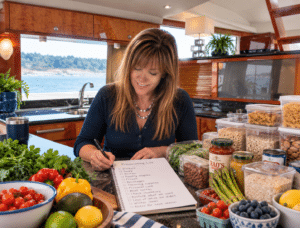
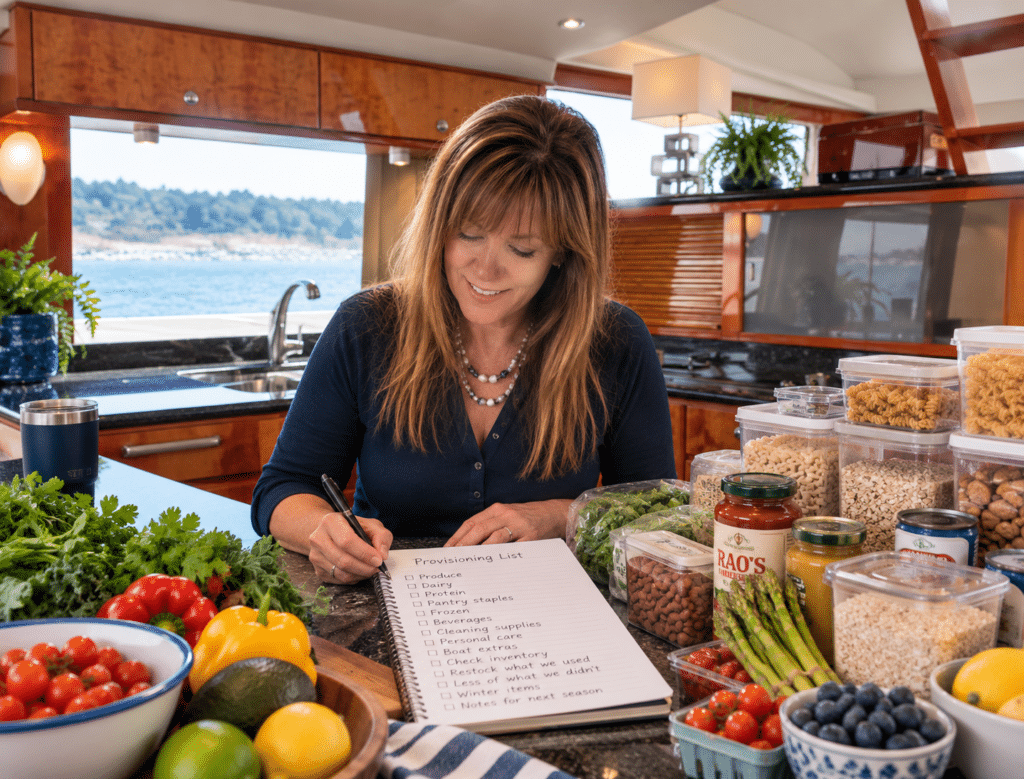
For all the technology onboard, one of my most useful provisioning tools remains decidedly low-tech. I have a provisioning list. And I use a pencil and an eraser.
Throughout the winter, as we finish things or I realize something needs replacing, I make notes directly on that list. If our habits change, I erase something and update it. By May, I don’t have to remember what happened eight months earlier. That list has improved every year because it’s based on what we actually use, not what I imagine we might use.
Read about and DOWNLOAD a copy of my list here:
I know how much moisturizer I need. I know how long my Premier Protein lasts. I know which pantry staples deserve backups and which don’t. I know I need fewer frozen lemons next year, more warm clothes and perhaps slightly less pasta.
That’s the difference between provisioning and simply buying groceries.
I Don’t Really Say Goodbye to the Boat
I don’t have a moment when I stand on the dock and feel as though summer is over. We keep using the boat through the winter, just differently. Some weekends we go down just for dinner, a hot tub, and a night onboard, then head home again.
I’ve realized that I don’t miss the boat when I’m home, and I don’t miss home when I’m on the boat. I think that’s because the two lives give me very different things.
On the boat, life gets smaller in the best possible way. I don’t have a car. I don’t have a garden that needs weeding or a list of errands to run. We can take the dinghy somewhere, sit on a beach, float in the water, or simply stay where we are.
At home, I get the other things I love. I have my horse and horseback riding, my garden, a big kitchen to cook in, a dressing room full of clothes and friends I can meet for dinner. I return to that life ready for it, just as, months later, I’ll be ready to leave it again.
Maybe that’s what the Great Boat Reset is really about. I’m not packing away one life to return to another. I’m simply shifting the balance. The linens get washed, the refrigerator gets cleaned, the pantry gets inventoried, and I’ve pencilled a few notes onto my provisioning list for May.
And somewhere between “buy fewer lemons” and “bring more warm clothes,” we’re already getting ready to do it all again.