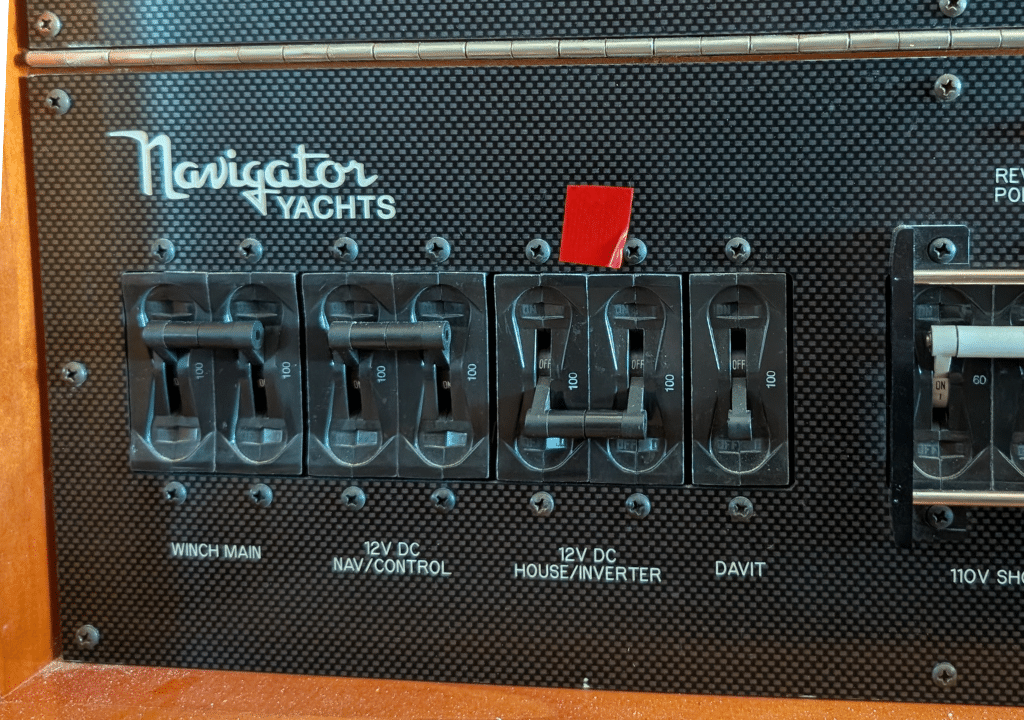
I do a few things every time I leave our boat. I make sure everything is secured, check that nothing is left running, take one last look around, and turn off the DC master. Whether I am leaving her at the dock or at anchor for a dinghy day trip. It has become such an automatic part of my routine that I hardly think about it anymore.
But I know exactly why I do it.
I worked with Jeff Cote at Pacific Yacht Systems for 12 years, and one of the things Jeff taught me was that when you leave your boat unattended, you don’t want unnecessary electrical circuits sitting energized. Turning off the DC master helps isolate those circuits, reducing the chance of an unnoticed load draining your batteries and limiting the number of energized circuits when nobody is there to notice if something goes wrong.
The important part, however, isn’t simply knowing which switch to turn off. It’s understanding what happens when you turn it off, and what doesn’t.
I learned that lesson on our own boat in a way I haven’t forgotten.
The Morning Our Port Engine Wouldn’t Start
We hadn’t owned the Navigator for very long and were still figuring out how all her systems worked. On a boat this size, that isn’t exactly a weekend project.
We had been at anchor for two nights without running the generator. We had solar, the days were still sunny, and our house bank was sitting at about 60 percent. Nothing about that particularly concerned us. More importantly, we’d left the dock only two days earlier with our engine-start batteries fully charged and had run the boat for about four hours. There was no obvious reason to think we had a start-battery problem.
It was Sunday morning, and we had to head home, but the port engine wouldn’t start. We used the crossover to start the engine and get home, but we called Pacific Yacht Systems when we got back to the dock to help us figure out what was happening. Their technician discovered something we never would have found on our own.
The boat was relatively new to us, so during our two days at anchor, we decided to start learning about the different systems. We fired up the furnace to test it. We didn’t know a previous owner had connected the furnace fans to the port engine start battery. A connection ran from that battery to a distribution bar hidden behind a wall.
While we were happily sitting at anchor, falsely assuming the furnace was another load on our house bank, those fans had quietly been drawing power from the battery we relied on to start the port engine.
It was a valuable lesson early in our ownership of the boat: knowing which switch turns something on isn’t the same as knowing where it gets its power.
What Does That Have to Do With the DC Master?
At first glance, not much, and that’s an important distinction.
Our engine-start batteries are a separate system. They aren’t supplied through the switched or non-switched DC distribution bars controlled by our DC master. They have their own charging arrangements and can be recharged through shore power, the generator or the engines’ alternators. Turning off our DC master would not have prevented what happened that morning.
That’s precisely why the experience was so useful.
I had made what seemed like a perfectly reasonable assumption. Start batteries start engines. They had been fully charged when we left the dock, we’d run the engines for several hours, and I had no reason to imagine that turning on the furnace would have anything whatsoever to do with them. I assumed nothing else was connected to them.
The experience taught me to stop thinking about our electrical system in terms of what it should do and start learning what it actually did. That lesson became even more important when Jeff explained switched and non-switched DC distribution.
Switched and Non-Switched Power
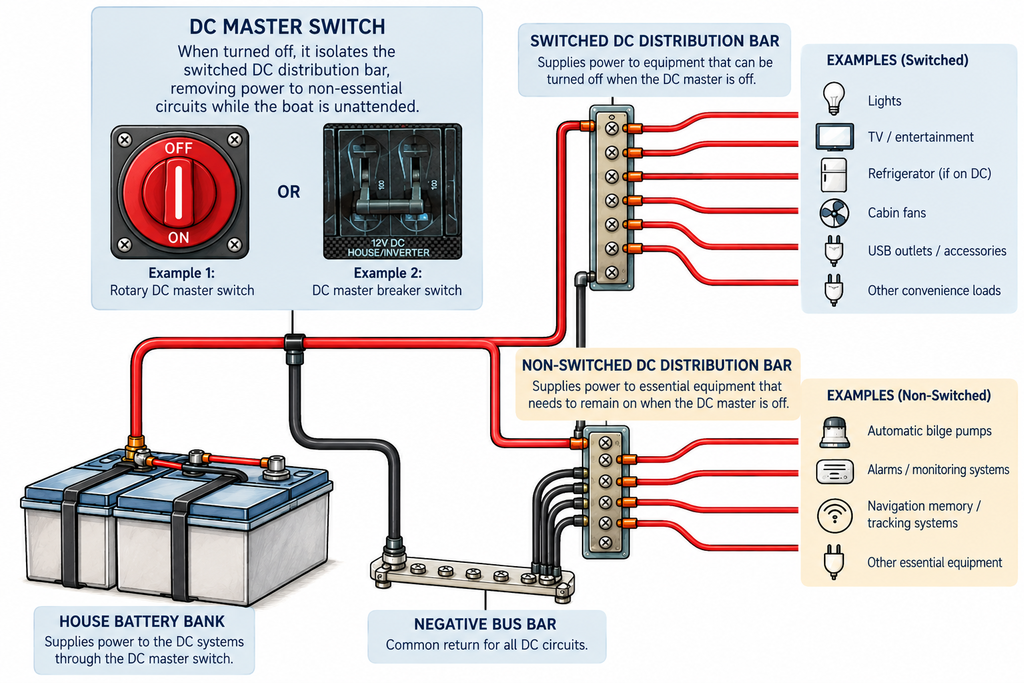
A well-designed boat electrical system doesn’t necessarily shut down every DC load when you turn off the master. Nor should it. The switched side supplies equipment you can isolate when you turn off the DC master. Lights, outlets and other non-essential equipment may be among those loads, depending on how the particular boat is designed.
However, some systems must remain powered even when nobody is onboard. Automatic bilge pumps are the obvious example. Depending on the vessel and its design, alarms, monitoring equipment, or other essential loads may also require uninterrupted power. You can wire these circuits so turning off the DC master doesn’t cut their power.
As our furnace adventure showed, some systems can be completely separate, like engine-starting circuits. The point isn’t that you should turn everything off when you leave.
The point is that everything should be intentionally connected to the appropriate source of power, and you should know which is which.
Why I Turn Off the DC Master
Once you understand that distinction, turning off the DC master becomes much more than another item on the departure checklist.
Electrical equipment doesn’t always stop consuming electricity simply because its display is dark. Something may have a standby load, an accessory may have been forgotten, or a piece of equipment may remain partially energized. A small load may not be noticeable over a few hours, but if you leave the boat for several days or weeks, those small loads can add up.
Another issue is leaving electrical circuits energized on an unattended boat. Marine electrical systems live in a demanding environment. Boats vibrate and move. Moisture finds its way into places we’d prefer it didn’t. Connections can loosen, wiring can chafe, and corrosion can develop. Good electrical design, proper circuit protection and regular inspections are the real foundations of a safe electrical system. Turning off the DC master doesn’t replace any of those things, nor does it eliminate every possible electrical problem.
It simply means I’m not leaving circuits energized when they don’t need to be.
And after discovering a hidden distribution bar behind a wall the hard way, I’m quite fond of that additional layer of protection.
What About the Bilge Pumps?
This is the question every boater should ask before simply walking down to the electrical panel and turning off the DC master.
What stays on?
Your automatic bilge pumps need to do their job when you’re not onboard. The same principle applies to any other essential equipment intentionally designed to remain operational while the boat is unattended.
Don’t assume yours is wired correctly just because that’s how it should be done. Boats acquire electrical history. Owners add equipment. Electronics are replaced. Owners install furnaces (ours was not from the factory), stereos, chargers, and monitoring systems after the fact. Someone needs power for something and finds a convenient source. Years later, the next owner inherits all of those decisions without necessarily knowing they were ever made.
We certainly did.
Before making the DC master part of your departure routine, understand what it controls. Confirm that the systems that need to remain operational still have power when it is turned off. Turn off your DC Master and go down and manually lift your bilge float; confirm it comes on. If you’re not sure, this is a great conversation to have with a qualified marine electrical technician.
Shore Power Is a Different Conversation
Turning off your DC master doesn’t necessarily disconnect your entire electrical system.
Your boat’s AC shore-power system and DC electrical system perform different jobs. Depending on how your boat is designed, battery chargers may keep running while you’re connected to shore power, even with your DC master off. Other equipment may also remain powered independently.
This is another reason I don’t particularly like rules that amount to “turn this switch off, and you’re done.”
Understanding why you’re turning it off is far more useful.
Jeff has always been particularly good at explaining complicated electrical systems in practical terms. During my 12 years working with him at Pacific Yacht Systems, I learned that electrical knowledge for boaters doesn’t mean you have to be able to repair the system yourself. It means understanding your boat well enough to know what questions to ask and when something doesn’t make sense.
Jeff explains the importance of turning off the DC master particularly well in this video:
Watch Jeff Cote explain the DC master
Know What Happens When You Turn the Switch
I still think about that morning at anchor when the port engine wouldn’t start. It would be easy to tell the story as a cautionary tale about a furnace fan connected to the wrong battery, but that isn’t really the lesson I took from it.
The furnace wasn’t connected to our DC master, and turning off the master wouldn’t have prevented what happened. Our start batteries are part of a separate system. That morning taught me something much more useful: never assume your boat is wired the way it “should” be. Know how it is actually wired.
That means understanding which equipment is supplied through your switched DC distribution, what is connected to the non-switched side and what operates independently of both. It means recognizing that some electrical loads are conveniences while others have much more important jobs. Your bilge pumps need to protect the boat when you’re not there. Your navigation equipment needs to work when you’re underway. Your starting batteries need to be ready when you turn the keys.
Working with Jeff Cote and Pacific Yacht Systems taught me to think of those systems as a whole, not as a collection of switches on a panel. Turning off the DC master when I leave the boat is part of that thinking. I’m not simply turning things off; I’m intentionally leaving the boat in the electrical state it was designed to be left in.
And if you don’t know what stays powered when you turn off your DC master, or where that power is coming from, that’s worth finding out before the day your boat decides to teach you.